 China VIN Report
How to Check the Repair and Accident History of a Used Car from China
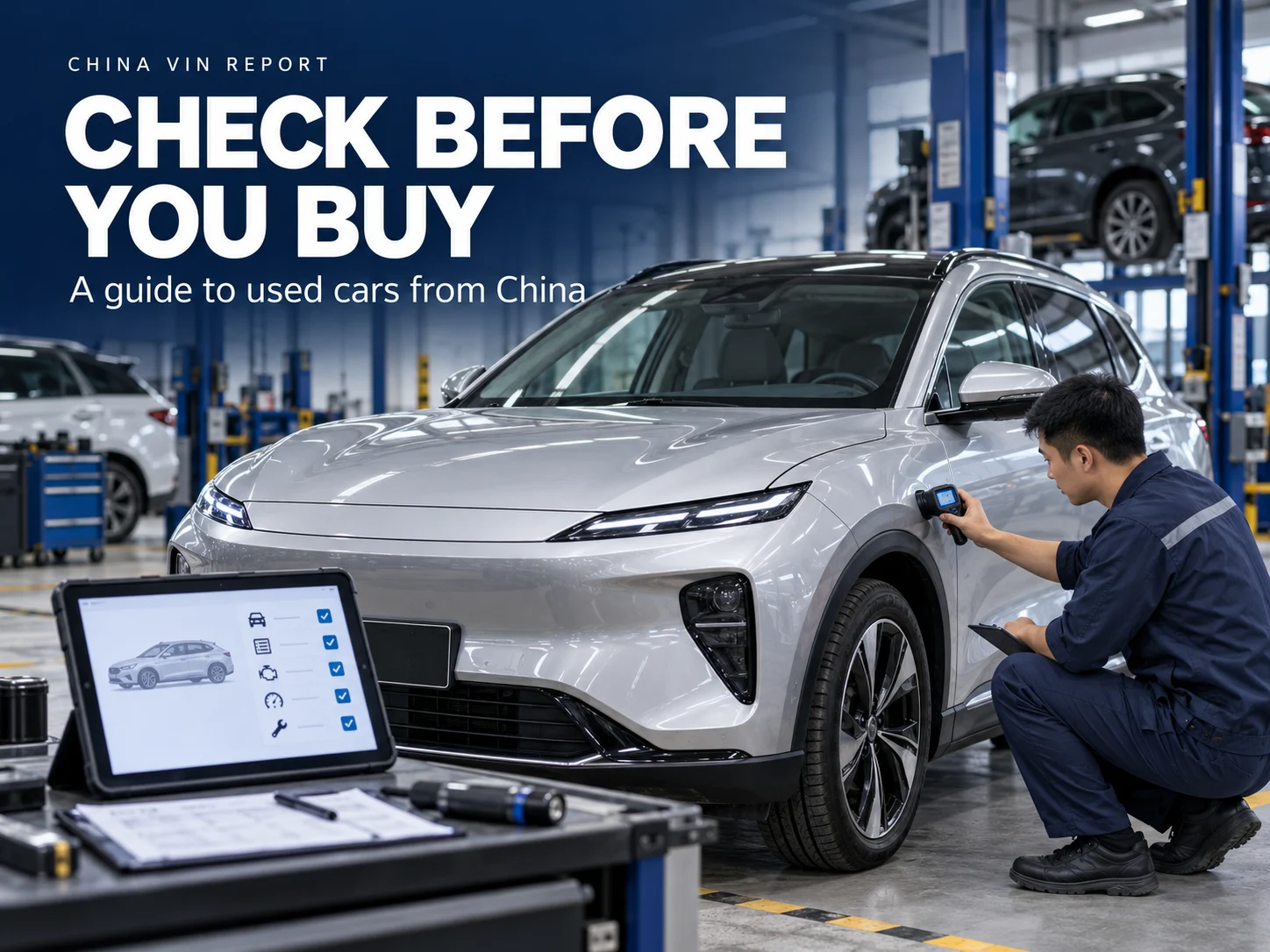
Buying a used car from China gives buyers access to a wide range of vehicle options. However, before making a purchase, it is important to look beyond the price, mileage, and exterior condition. Understanding a vehicle's maintenance history, repair records, and potential accident history can all influence the final purchasing decision.
For users of our platform, verifying this information is not always easy. You may be unable to visit China in person to inspect a vehicle, and you may not be able to independently confirm whether every detail provided by the seller is accurate.
Nevertheless, there are several ways to learn more about a vehicle's history before deciding to buy it. Reviewing available records, asking the seller specific questions, and arranging an independent physical inspection when necessary can help you make a more informed purchasing decision.
1. Understanding Repair History and Accident History
Repair history primarily covers maintenance and repair work previously performed on a vehicle. Depending on the available records, this information may include routine servicing, component replacements, mechanical repairs, or bodywork.
Accident history primarily concerns accidents involving the vehicle and any related damage. Depending on the data source and its coverage, available information may include recorded accident events or insurance claims.
These two types of records can provide different clues. For example, a repair invoice may document the replacement of a component without indicating whether the vehicle was involved in an accident. Conversely, an accident or insurance claim record may indicate that damage was reported, but it may not contain a complete record of all subsequent repair work.
Historical records also differ from a physical vehicle inspection. Historical records reflect information that has been documented and is available for review, while a physical inspection assesses the vehicle's actual condition at the time of inspection.
Therefore, buyers should consider three sources of information together: available repair records, accessible accident-related information, and the vehicle's current physical condition.
2. Verify the Vehicle's VIN Before Checking Its History
Before investigating a vehicle's history, first confirm that the information you are reviewing actually belongs to the vehicle you intend to purchase.
The Vehicle Identification Number (VIN) is an important reference for verifying a vehicle's identity. You should compare the VIN on the vehicle itself with the information in the relevant documents, the details provided by the seller, and the VIN shown in any vehicle history report.
Pay particular attention to the following:
Whether the VIN on the vehicle matches the VIN in the relevant documents.
Whether the make, model, and specific version listed in the report match the actual vehicle.
Whether the model year and other identification details are consistent.
Whether the vehicle covered by the report is the same vehicle the seller is offering for sale.
If you discover any inconsistencies, ask the seller to explain them clearly before proceeding with further checks.
Independently checking VIN-related information can also help you verify the vehicle's details and avoid relying entirely on a report provided by the seller.
3. Review Available Repair and Maintenance Records
When investigating a vehicle's history, you can ask the seller for available maintenance records, repair invoices, repair summaries, service booklet entries, or other documents related to previous repairs.
These materials may help you understand what work has been performed on the vehicle and when the work took place.
When reviewing the records, pay particular attention to the following key aspects:
Dates and Mileage: Compare the date of each repair or maintenance visit with the corresponding mileage reading. Check whether the figures form a reasonable progression over time.
Repair Details: Check whether the records clearly explain the problems identified and the repairs actually carried out.
Replaced Components: Pay attention to replacement records involving major mechanical components, safety-related systems, or parts that may require further inspection.
Recurring Problems: If multiple repair records refer to the same component, further investigation may be necessary to determine whether the original problem has been resolved.
Supporting Documentation: Where possible, ask the seller to provide repair invoices, relevant photographs, or other materials that may help verify the repair history.
It is important to remember that repair records do not necessarily indicate that a vehicle has problems. Routine maintenance and the replacement of worn components are normal parts of vehicle ownership. What matters most is the nature of the repairs, the quality of the work, and the vehicle's current condition.
4. Check Available Accident and Insurance Claim Information
Accident and insurance claim information can provide additional clues about a vehicle's past condition.
If relevant records are available, pay attention to the accident date, descriptions of recorded damage, the affected areas of the vehicle, and any claim amounts listed in the report.
Do not judge the severity of an accident solely by the insurance claim amount. Parts prices, labor costs, repair methods, and other factors can all affect the final repair cost. A single claim record also cannot necessarily establish whether a vehicle has structural damage or determine the quality of subsequent repairs.
A more practical approach is to use the available information to identify issues that require further investigation.
For example, if a record indicates that the front of a vehicle was damaged, ask the seller for details about the incident, the affected components, and any supporting repair documents. If the record raises concerns about the vehicle's structural integrity, arrange an appropriate physical inspection before making a purchase decision.
China VIN Report provides an accident and insurance claim history checking service, helping users access available accident-related information and insurance claim records.
Learn more: Check Accident and Insurance Claim History
Please note that the information returned depends on the available data sources and their coverage. Unreported accidents, repairs paid for directly by vehicle owners, and records that cannot be accessed may not appear in the results. The absence of an accident record does not prove that a vehicle has never been damaged or involved in an accident.
5. Look for Signs of Previous Repairs During a Physical Inspection
Historical records alone cannot fully establish a vehicle's current physical condition. Therefore, where possible, it is advisable to combine historical information checks with an independent physical vehicle inspection.
Depending on the scope of the inspection, the following inspection areas deserve particular attention:
Inspection Area | Key Focus & Signs of Previous Repairs |
|---|---|
Body Panels and Paintwork | Look for differences in color, paint texture (such as orange peel or overspray), or irregular panel gaps that may warrant further investigation. |
Structural Areas | Check relevant structural components (A/B/C pillars, crumple zones, and frame rails) for signs of previous repairs, welding, or bench pulling marks. |
Chassis and Undercarriage | Within the scope of the inspection, look for visible impact damage, corrosion, structural cracking, or signs of non-factory repairs. |
Mechanical Components | Check for visible fluid leaks, unusual noises during operation, or reported system faults involving relevant powertrain and steering components. |
Safety-Related Components | Pay particular attention to damage or previous repairs affecting vehicle safety, including airbags, seatbelts, and braking systems. |
These signs must be assessed in context. For example, differences in paintwork or a replaced body panel do not, on their own, prove that a vehicle has been involved in a major accident. Similarly, a clean exterior does not guarantee that there is no hidden damage.
If a report has already identified a specific issue, ask the inspector to focus on the relevant areas within the agreed inspection scope.
For overseas buyers who cannot travel to China to inspect a vehicle in person, arranging an independent on-site vehicle inspection can help establish its actual condition at the time of inspection.
Learn more about the Chaboshi On-Site Vehicle Inspection Service. Before arranging an inspection, confirm whether the service covers your specific vehicle, as well as the inspection scope, scheduling, and fees.
6. Compare Mileage Records with Repair Records
Mileage information can help you assess whether a vehicle's historical records are consistent.
If dated mileage readings are available, compare them in chronological order. If a later record shows lower mileage than an earlier one, further investigation is necessary. Long gaps between records or unexplained inconsistencies may also indicate that additional verification is needed.
However, gaps in the records do not automatically mean that the odometer has been tampered with. Repair and maintenance records usually document mileage at specific points in time rather than recording every kilometer the vehicle travels.
If the available mileage information raises concerns, ask the seller for additional documents and a photograph of the current dashboard. Also, confirm that the information relates to the same vehicle and that the dates and mileage units have been interpreted correctly.
China VIN Report provides a Mileage Verification Service that allows users to compare available dated historical mileage readings.
This service can help identify inconsistencies. However, a continuous and seemingly reasonable mileage history does not conclusively prove that the odometer has never been altered.
7. What Should You Do If Records Are Incomplete or Inconsistent?
Sometimes, the information available online does not provide a complete picture. In such cases, the following steps can help you investigate further:
Step 1: Ask the Seller for an Explanation: Ask the seller to explain unusual repairs, mileage discrepancies, or accident-related records.
Step 2: Request Supporting Documentation: Ask for relevant repair invoices, maintenance records, photographs, or other information that may help verify the vehicle's history.
Step 3: Compare Information from Different Sources: Compare the available vehicle data with the seller's explanations and the documents they provide.
Step 4: Arrange Further Inspection if Necessary: If important questions remain unresolved after reviewing the documents and historical information, consider arranging an independent physical inspection and identifying the areas that require particular attention.
Step 5: Reassess Whether to Purchase the Vehicle: If significant inconsistencies remain unexplained, consider postponing payment, renegotiating the price based on verified findings, or choosing another vehicle.
These steps cannot guarantee that every problem will be discovered. However, they can help you distinguish between issues supported by evidence, questions that remain unresolved, and risks requiring further investigation.
8. Pre-Purchase Repair and Accident History Checklist for Used Cars in China
Before purchasing a used car from China, you can use the following checklist to organize the information that needs to be verified:
Verification Item | What to Check |
|---|---|
Vehicle Identity | Confirm that the VIN on the vehicle and in the relevant documents matches the VIN in the history report. |
Repair Records | Request available maintenance records, repair invoices, and related documents. |
Mileage History | Compare dated historical mileage readings and investigate unexplained discrepancies. |
Accident-Related Information | Review available accident records and insurance claim information. |
Seller's Explanation | Ask specific questions about major repairs or recorded damage. |
Actual Vehicle Condition | Consider arranging an independent physical inspection if questions about the vehicle's condition remain. |
Inspection Scope | Confirm which components and functions are covered by the selected inspection service. |
Final Decision | Resolve significant questions as far as possible before making payment or arranging shipment. |
9. How Can China VIN Report Help You Verify a Vehicle?
For overseas buyers, verifying a used car from China usually requires a combination of methods rather than relying on a single report.
China VIN Report provides vehicle information checking services that help buyers review available historical information, including accident and insurance claim details, as well as dated historical mileage readings. Its Chaboshi service also supports buyers seeking information about arranging on-site vehicle inspections in China.
Different services serve different purposes. Online checks rely on available historical data and its coverage, while an on-site inspection assesses the vehicle's actual condition within the agreed inspection scope.
Neither method can guarantee the discovery of every previous repair, accident, or hidden mechanical fault. If important questions remain unresolved, additional evidence or a more targeted inspection may be necessary.
For overseas buyers, the key is to establish as clear and reliable a picture of the vehicle as possible before making a purchase.
To learn more about the available services, visit the China VIN Report official website.
Conclusion
Checking the repair and accident history of used cars in China is not simply about finding a record indicating that a vehicle has been damaged. What really matters is understanding what the available information can tell you, identifying gaps or inconsistencies, and determining whether further verification is necessary.
By reviewing available repair documents, comparing mileage records, checking accessible accident-related information, and arranging an independent physical inspection when appropriate, buyers can develop a more comprehensive understanding of a vehicle's condition.
Combining historical information with an assessment of the vehicle's current physical condition helps overseas buyers ask more precise questions, evaluate potential risks more carefully, and make better-informed purchasing decisions.