 China VIN Report
Chassis Inspection for Used Electric Vehicle Battery Packs: 6 Easily Overlooked Hidden Hazards
Lifting to Inspect the Chassis: 6 Hidden Defect Checkpoints on the Bottom of Used Electric Vehicle Battery Packs Many potential hazards are hidden at the bottom of the battery pack, which cannot be…
Lifting to Inspect the Chassis: 6 Hidden Defect Checkpoints on the Bottom of Used Electric Vehicle Battery Packs
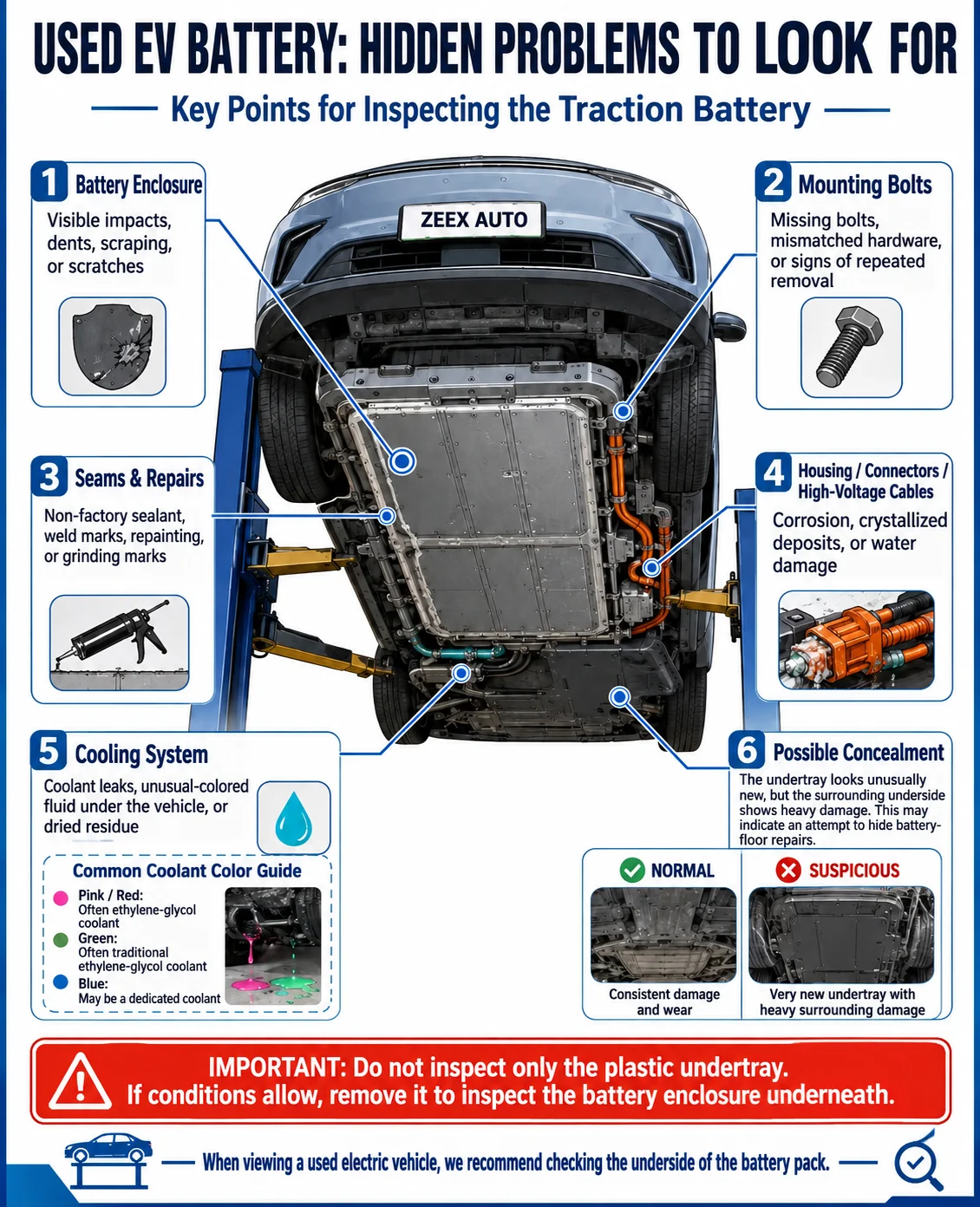
Many potential hazards are hidden at the bottom of the battery pack, which cannot be seen at all through the protective plate. When purchasing a second-hand new energy vehicle, be sure to lift the vehicle and remove the lower protective plate to inspect the battery pack. Below are 6 hidden faults of the chassis battery that we focus on checking during export vehicle inspection:
Battery bottom case
Check for dents, bumps, undercarriage scratches, and punctures. Damage to the outer casing will compromise the seal, significantly increasing the risk of water ingress and electric leakage at a later stage.
Fixing Bolt
Check whether there are missing bolts, inconsistent bolt specifications, or traces of repeated assembly, disassembly and tightening; if any of these signs are found, the battery pack has most likely been disassembled and repaired.
Seams and repair marks
The original factory sealant is neat and uniform. If there are signs of subsequently applied sealant, solder joints, touch-up paint, or sanding marks, it indicates that the battery pack has been opened and repaired.
Housing, Plug and High-Voltage Wiring Harness
Check the positions of high-voltage plugs and wiring harnesses, and focus on rust, white crystals and water stains, which are typical signs of wading or being soaked in water.
Cooling System
Check for coolant leaks and any traces of dried fluid on the chassis. Coolant of different colors — pink/red, green, blue — can help with identification; any detected leak is classified as a high-risk issue.
Suspicious maintenance traces
The skid plate is brand new, but the surrounding chassis is heavily scarred. It is a very common trick for sellers to replace the skid plate with a new one to cover up the undercarriage impact and repair traces of the battery.
✅ Important Reminder
Do not just make a rough observation through the lower plastic guard; if conditions permit, be sure to remove the guard and conduct a complete visual inspection of the bottom of the battery pack.
Only by combining the two items, namely battery pack undercarriage inspection and BMS computer reading of SOH, fault codes and cell data, can the actual condition of the battery be fully evaluated.
FAQ
Q1: Can we tell whether there is damage to the bottom of the battery pack just from photos?
A:No. Photos may be affected by shooting angles, photo retouching, or the plastic underguard being blocked. To confirm dents, leaks, or disassembly and reassembly traces, the vehicle must be lifted, the plastic underguard removed for visual inspection, and supported by multi-angle original on-site photos.
Q2:Does over-tightening a bolt necessarily mean that the battery pack has been in an accident?
A: Not necessarily. For some vehicle models, bolts are also removed during factory inspection and routine maintenance; however, the disassembly and reassembly of multiple bolts, inconsistent specifications, and missing bolts are high-alert signals, which require further verification of the sealant and fault codes to comprehensively determine whether the cover has been removed for repair.
Q3: Does installing a new lower guard plate definitely mean the merchant is covering up a problem?
A: This is a key suspicious sign: the skid plate is brand new, but there are obvious undercarriage scratches on the surrounding chassis and frame, which is highly likely to be a cover-up for battery pack damage; we will remove the skid plate to directly show the condition of the battery unit.
Q4: What does the white crystal appearing on the high-voltage plug mean?
A: Crystallization is the trace left by the oxidation of leaked water vapor or electrolyte, which is a risk signal of water exposure or immersion. It is prone to high-voltage failures and abnormal charging subsequently, so it is not recommended for purchase.
Q5: For chassis battery inspection, what additional tests are required to be carried out in combination?
A: The visual inspection of the chassis is the first step. We also need to read the BMS data, including SOH state of health, cell voltage difference and historical fault codes, plus a charge-discharge test, to complete a full assessment of the battery through the entire process.
。