 China VIN Report
How to check the battery health of a used electric vehicle?
Buying second-hand electric vehicles from China gives overseas buyers access to a wider range of models and price options. However, before selecting a vehicle, they should not only focus on the…

Buying second-hand electric vehicles from China gives overseas buyers access to a wider range of models and price options. However, before selecting a vehicle, they should not only focus on the vehicle's appearance, mileage and nominal range, but also need to understand the actual condition of the power battery.
High-voltage power battery is one of the most critical components of a battery electric vehicle. The condition of the battery can affect the actual driving range, charging performance, subsequent operating cost of the vehicle, as well as whether it is suitable for daily use.
For overseas buyers, if the vehicle is located within China and they are unable to inspect it in person, verifying the battery condition can be even more challenging. While the seller's description and the driving range indication on the dashboard can serve as reference information, neither can fully reflect the actual health status of the battery.
This article will introduce how to evaluate the battery health of a used electric vehicle before purchasing, how to interpret battery inspection reports, and under what circumstances further professional inspection should be arranged.
I. Understanding What Battery Health Status Means
Before inspecting a used electric vehicle, it is first necessary to distinguish between the battery health status and the current battery level.
State of Charge (SOC) of a battery indicates the current remaining power of the battery and its level relative to the available capacity of the battery. It is similar to the fuel gauge in a traditional fuel vehicle.
State of Health (SOH) is used to describe the health level of a battery relative to a certain reference state, typically taking the state of a new battery as the reference. Depending on the specific vehicle model and evaluation method, SOH may reflect the remaining capacity, or be evaluated based on other battery state indicators.
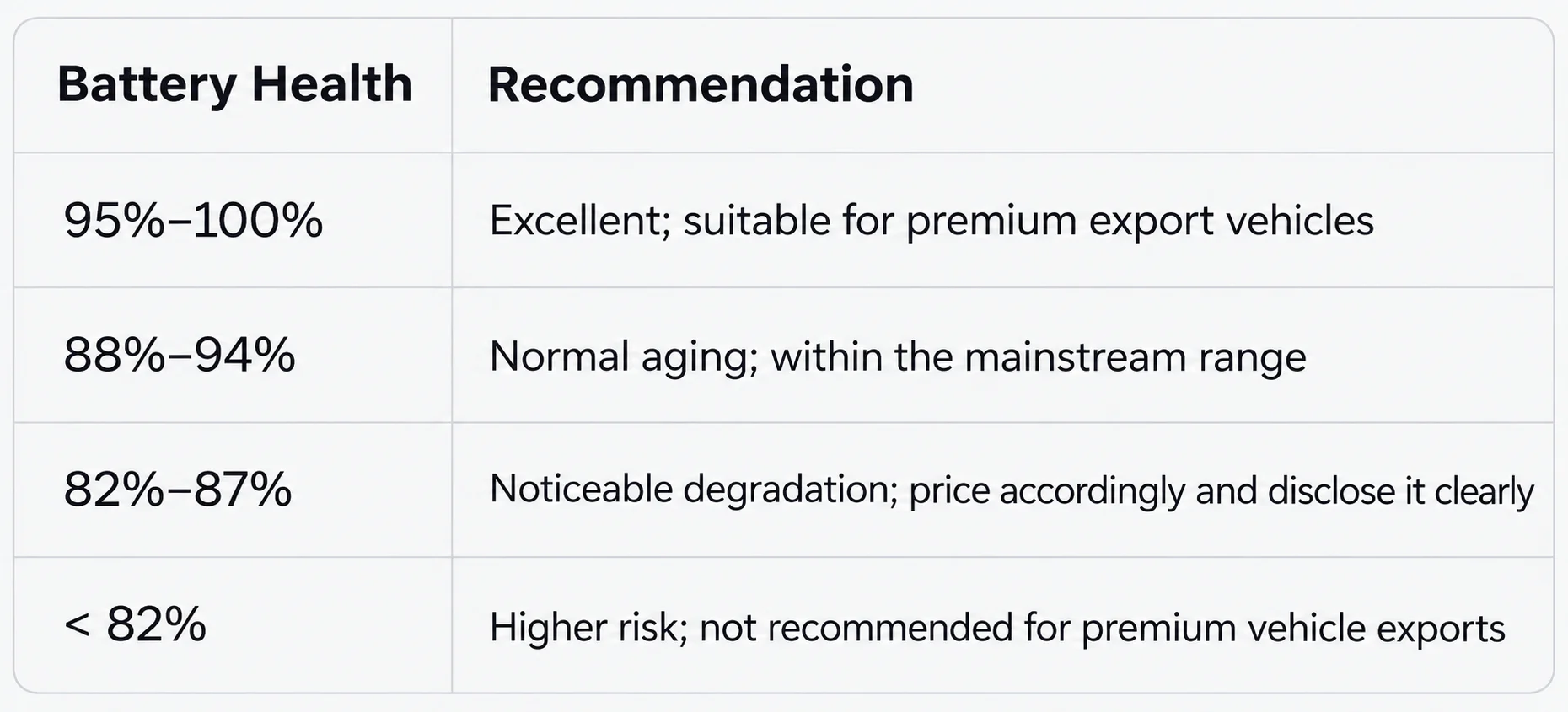
These two values serve different purposes. A higher battery charge level does not necessarily mean the battery is in good health, just as a lower charge level does not automatically indicate that the battery has undergone significant degradation.
For buyers, what they really need to know is not just how much charge the battery currently has, but how much usable energy it can still deliver, whether it is functioning properly as expected, and whether there are any signs of faults or damage that require further investigation.
Before comparing the SOH values provided by different vehicles or different institutions, one should first confirm the definition, calculation method and measurement basis of such values.
II. Request a Battery Health Check Report
Battery health inspection reports may provide some information that cannot be directly obtained through visual inspection or dashboard readings.
Depending on the vehicle model, diagnostic method and available data, the report may include battery health assessment, charging-related information or other battery status indicators.
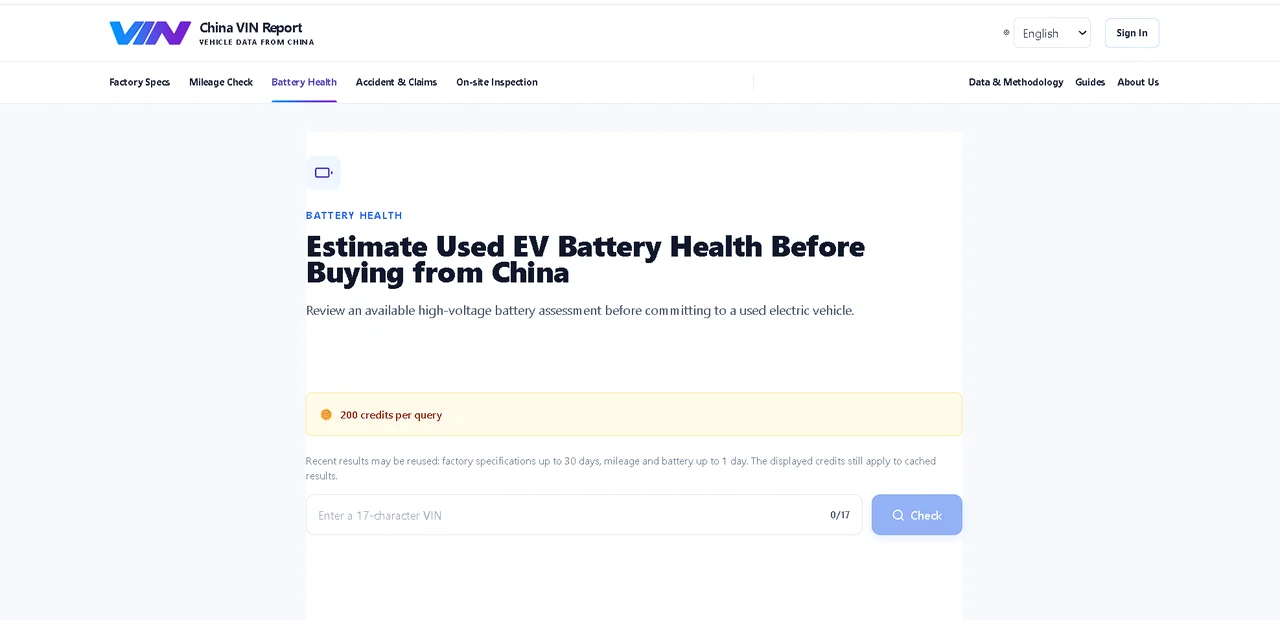
China VIN Report provides battery health diagnosis services for the supported battery electric vehicles and plug-in hybrid electric vehicles.
This service uses available vehicle and battery-related data for evaluation. Depending on the specific vehicle model and data coverage, the result may be an estimate rather than a direct measurement of the battery's actual usable capacity.
This distinction is particularly important if the condition of the battery significantly affects the purchase price or utility value of the vehicle.
3. Inspect the battery pack and chassis for visible damage
There are obvious dents or deformation on the battery casing or its surrounding area.
There is damage on the underside of the vehicle that may have been caused by a collision.
There are signs of corrosion on the relevant parts or damage related to water ingress.
A warning message that may be related to a battery or related system failure appears.
These phenomena do not directly prove that the interior of the battery has been damaged. Likewise, the absence of visible abnormalities on the surface of the battery casing does not guarantee that every internal component is functioning properly.
Do not open the high-voltage traction battery pack by yourself or attempt to inspect its internal components. The high-voltage system poses severe risks of electric shock and safety hazards, and internal inspection and maintenance shall be performed by qualified professionals with appropriate equipment and operating procedures.
IV. Charging Stress Testing
Slow Charging Equalization
Slow charging helps the battery achieve self-balancing. If the power drops sharply too early in the late charging stage, it usually indicates significant battery degradation or high balancing pressure.
DC fast charging
Fast charging is the most critical stress testing. In the high-current range where the battery level is between 30% and 70%, observe whether the power, temperature and cell voltage remain stable. If there are repeated power reductions, charging disconnection, or continuous voltage drop in a certain cell, an in-depth re-inspection is required.
For plug-in hybrid electric vehicles (PHEVs), additional tests on all-electric mode, hybrid mode switching, and battery hold mode shall be conducted to verify smooth coordination among the clutch, generator and battery; many faults of PHEVs do not lie in the battery itself, but in the hybrid transmission mechanism.
FAQ
Q1: Is a high battery health level always a guarantee of no issues?
No. SOH is only a comprehensive estimation, which can be easily temporarily beautified by standing, cooling or resetting. It is necessary to simultaneously check the cell voltage difference, cooling system and historical faults, and complete fast charging and road test verification.
Q2:Can battery packs with opened covers still be exported?
It depends on the repair items. If the repair only involves sealing treatment, replacement of external pipelines, and has undergone complete testing, the product can be shipped under the premise of truthful disclosure; if the repair involves battery cells, modules or battery management boards, it is a high-risk case, and the product must be sold at a discounted price with prior notification to the buyer.
Q3:Is it necessary to replace the battery when the pressure difference is large?
Not necessarily. Mild imbalance can be corrected through balanced charging. However, if the voltage difference widens rapidly after fast charging or temperature rise, it usually indicates that the battery cells have undergone irreversible aging, and the probability of subsequent problems recurring is very high.
Q4: What's the difference between plug-in hybrid and pure electric vehicles in battery inspection?
For plug-in hybrid vehicles, in addition to the battery, key testing items include hybrid mode switching, battery charge retention, generator charging, and clutch coupling. Many complaints about plug-in hybrids do not stem from the battery itself, but rather from the wear and impact of the hybrid transmission system under high load.