 China VIN Report
How to check whether a used car may have been flooded
Flood-damaged vehicles are the most tricky "invisible bombs" in the used car trade. Repair shops can thoroughly clean up all surface traces by washing, drying, replacing carpets and spraying…

Flood-damaged vehicles are the most tricky "invisible bombs" in the used car trade. Repair shops can thoroughly clean up all surface traces by washing, drying, replacing carpets and spraying deodorants. It is not until the vehicles are loaded onto ships and arrive at their destinations that problems such as corroded wiring harnesses, leaking batteries and electronic control system failures will break out one after another, which often lead to claims, return shipments and huge losses.
For car exporters and overseas buyers, flood damage inspection should not rely solely on sniffing for musty odors; instead, one should follow the pattern of water flow and sedimentation to layer by layer uncover the concealed evidence.
Here are some identification methods:
1. Smell the scent
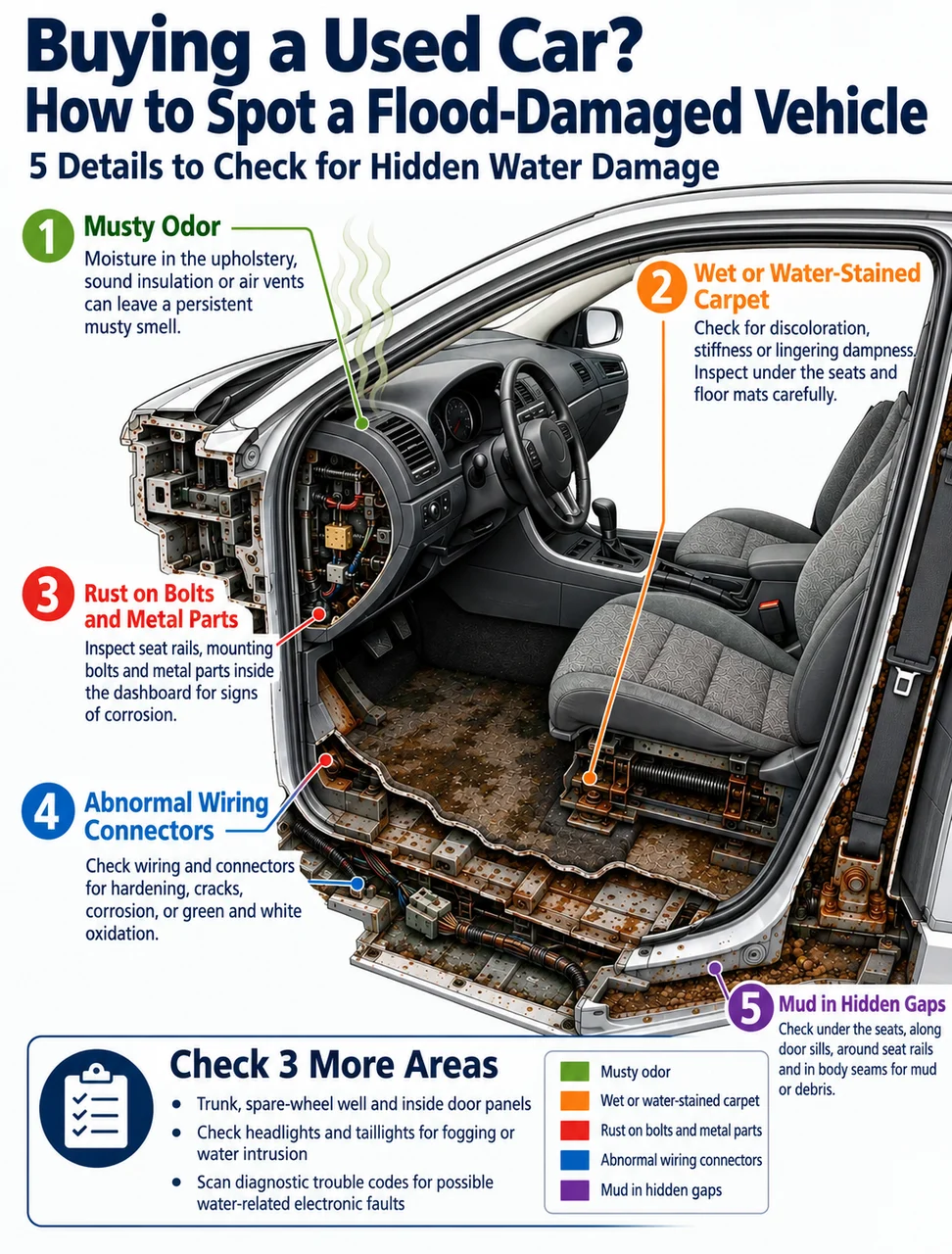
Generally, for a water-damaged car, water will seep into the interior, leaving a musty smell inside the vehicle. If the used car you are buying has an unusually strong scent of perfume or air freshener, you need to pay extra attention to check whether this is being used to mask the moldy odor.
2. Check the seatbelt
Unfasten the car's seatbelt and check whether its front and rear sections are of the same age, and whether the production date of the seatbelt matches the date on the vehicle's nameplate; if there is any discrepancy, the vehicle can be confirmed to be a flood-damaged car.
3. Check the trunk
Open the trunk, lift the trunk lid, check for water stains in the corners and inspect the rust condition of the on-board tools. In addition, if the spare tire of this car is very new but the wheel hub shows obvious rust, it proves that there was once accumulated water in the trunk, and the car is most likely a flood-damaged vehicle.
4. Check the appearance
Check the interior of the front and rear light clusters, especially the silver lamp reflectors, for any yellowish stains caused by water immersion; check whether the front and rear light clusters are excessively new, and verify if the wear level of the headlight cluster matches the age of the vehicle.
5. Check the engine room
Open the hood and locate the car's fuse box. Check if there is any silt or loess powder inside the fuse box; if so, the car is a flood-damaged vehicle.
6. Test Drive Experience
During the test drive, listen carefully to whether the engine noise is relatively loud and whether there are any unstable conditions. Even if the engine has been overhauled, a flood-damaged car may still have a small amount of water seep into the engine, which could interfere with its normal operation, and replacing the entire engine would be extremely costly.
FAQ (Frequently Asked Questions):
Q1: If you only smell a musty odor, does that definitely mean the car is a flood-damaged one?
No. A damp smell can also be caused by a leaking sunroof, a blocked air conditioning drain pipe, or rainwater seeping through the door rubber seals. The musty smell is only an early warning sign and cannot be used as the sole basis for judgment. It needs to be cross-verified with multiple pieces of evidence such as sediment in the seat rails, verdigris on wiring harness connectors, and salt stains in the spare tire compartment.
Q2: If the fault code has been cleared, can the traces of water immersion still be detected?
Yes. Even after the current fault is cleared, many vehicles will retain historical freeze frames, insulation records and communication faults. For EVs/PHEVs, re-scanning after fast charging and full-load road tests often allows temporarily masked high-voltage and insulation faults to reappear.
Q3:What is the most dangerous part of new energy flood-damaged vehicles?
This refers to the high-voltage circuit. Continuous corrosion of the battery tray, power distribution box and high-voltage wiring harness by salt will lead to degraded insulation and pre-charging failure, and in severe cases, trigger thermal protection or even pose a risk of fire. Even if there is no alarm at the moment, faults are likely to break out intensively after the high temperature and vibration during ocean shipping.
Q4: Does replacing the carpet and seats mean that the car was once flooded?
Not necessarily. Some cases are caused by spilled coffee or beverages, or interior refurbishment. However, if the following signs appear simultaneously: yellowed seatbelts, dirt buildup on the slide rails, cleaned fuse box, and verdigris on multiple connectors, it strongly points to a flood-damaged vehicle. Replacing interior parts alone is a major red flag that requires in-depth re-inspection.