 China VIN Report
How to determine whether a used car has undergone major repairs by measuring the thickness of its paint film?
During the used car inspection process, the vehicle's exterior is often the first part that buyers pay attention to. Even if a car has a shiny exterior and a tidy body, it does not mean that it has…

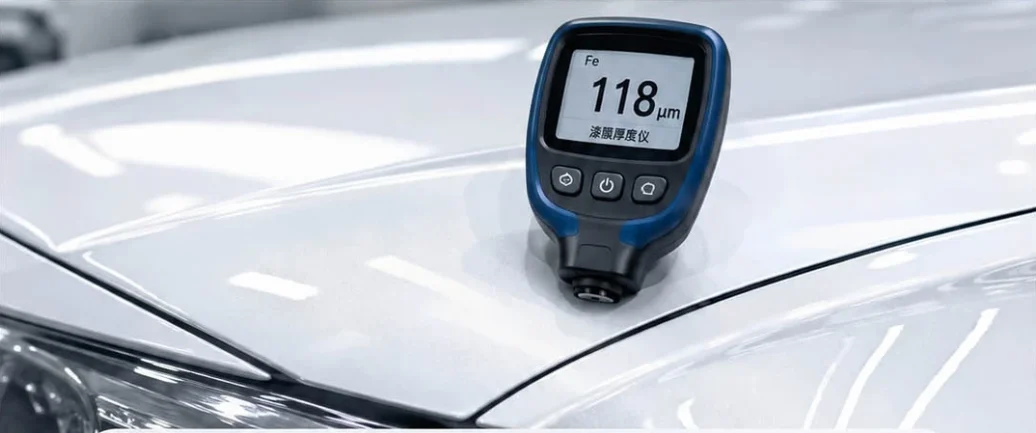 During the used car inspection process, the vehicle's exterior is often the first part that buyers pay attention to. Even if a car has a shiny exterior and a tidy body, it does not mean that it has never been in an accident or undergone repairs.
Some vehicles may have undergone localized touch-up painting, full-panel repainting, or even sheet metal repair. It is difficult to accurately identify these repair traces solely through visual inspection. A paint thickness gauge can be used to determine whether a vehicle has been repainted, undergone sheet metal work, or putty repair, making it a fundamental tool for identifying vehicles with accident-related repairs.
I. What is a paint film thickness gauge?
A paint film thickness gauge is a professional testing tool used to measure the thickness of the coating on the surface of an automobile body. It can measure the coating thickness between the paint finish and the metal base material without damaging the car paint, helping inspectors identify the differences in paint finish across different parts of the vehicle body.
Working principle: The probe bounces back after hitting the sheet metal to read the thickness between the sheet metal and the paint surface, and the instrument calculates the coating thickness based on the detected signal changes.
It should be noted that a paint film thickness gauge can only provide data on the thickness of the paint coating, and cannot independently prove whether a vehicle has been involved in a major accident. Inspectors also need to make a comprehensive judgment by combining the body structure, welding spots, screw disassembly traces and maintenance records.
II. Paint Film Thickness Gauge Usage Tutorial: How to Correctly Test Car Paint Surfaces?
Obtain the reference value: Priority shall be given to taking measurements at 5 different points on the vehicle roof, and calculating the average value as the reference value of the original paint of this vehicle (the original paint of most family cars ranges from 80 to 150 microns).
Detection points: Inspect metal components including the engine hood, four doors, fenders, ABC pillars, and trunk lid in sequence, take 3-4 measurements on each part, and ensure the probe is vertically and tightly attached to the paint surface to avoid value deviation caused by tilting.
Numerical Judgment:
If the reading is within ±20μm of the reference value: original factory paint, no repair.
Value 120-200μm: minor touch-up paint, no body panel beating.
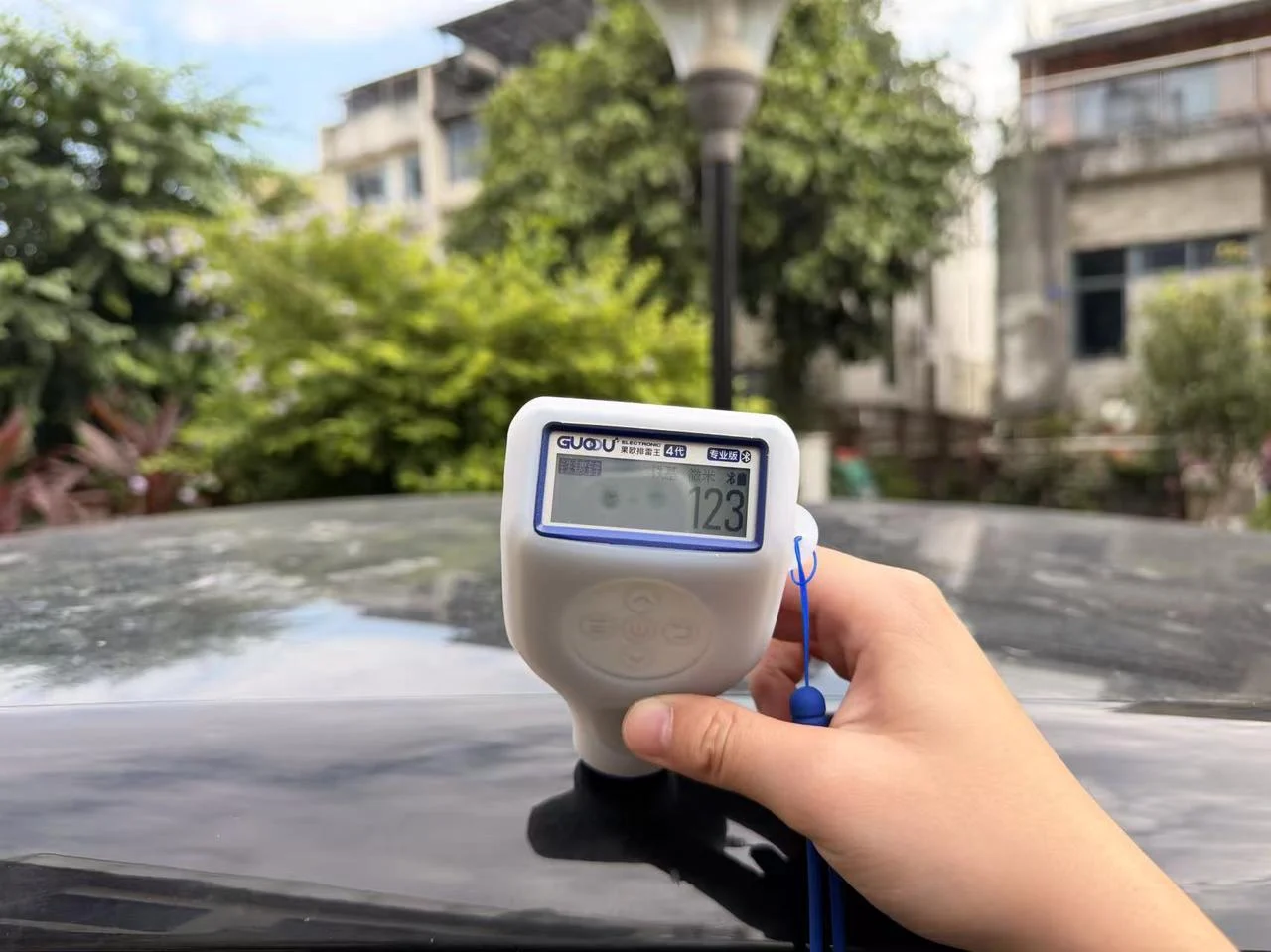 Reading of 200μm or higher: indicates sheet metal repair; the higher the reading, the thicker the putty, and the more severe the collision deformation.
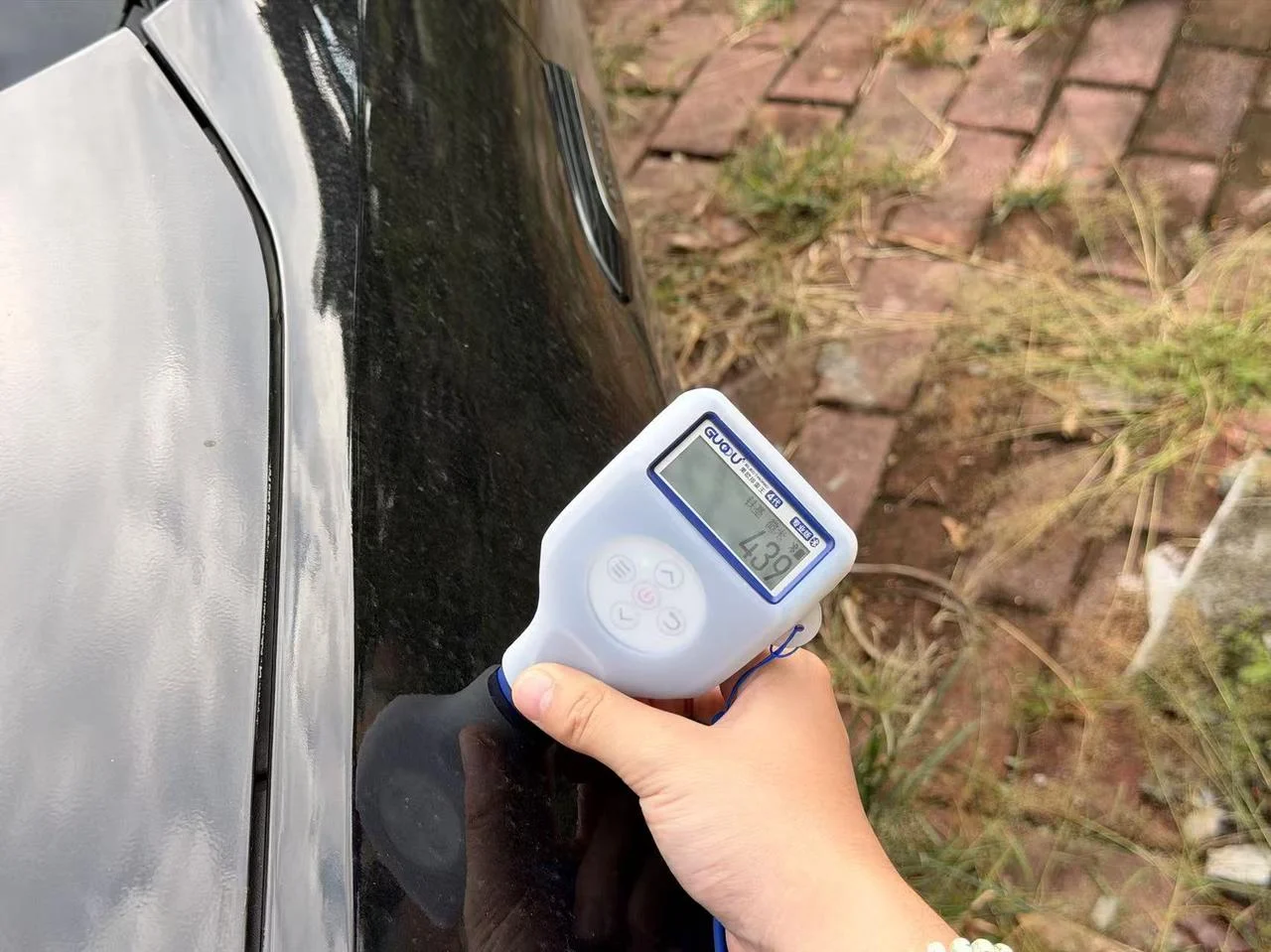 If the value exceeds 1000μm: the putty layer is too thick, which indicates a high probability of severe collision or cutting repair in the past.
Auxiliary Verification: Test multiple points when values are abnormal
Even if the readings are normal, you need to check whether there are signs of tampering on the door hinge screws, so as to prevent "used dismantled parts" from covering up accident traces.
III. Key Precautions
Detection Scope Limitation: This device can only detect metal components. Non-metallic parts such as plastic bumpers and glass cannot be detected. If you force a detection on such parts, no response will be displayed, which is a normal phenomenon.
Cause of Numerical Deviation:
Tilt of the probe, dust or water droplets on the paint surface will lead to higher readings.
Original factory paint inherently has process-related variations, with different vehicle lines featuring varying thicknesses (Japanese models tend to have thinner paint while German models have thicker ones), so the reference should be the baseline value of the specific vehicle rather than a fixed number.
Accident judgment logic: A paint film thickness gauge can only reflect the thickness of the car paint surface and cannot directly determine whether a vehicle is an "accident car"; a comprehensive judgment combining welding spots, chassis, OBD and other factors is required. If high values are detected on structural components (A/B/C pillars, frame rails), the associated risk is far higher than that of repaired body panels.
FAQ
Q1:Can a paint film thickness gauge detect all parts of a car?
No. Ordinary magnetic induction and eddy current film thickness gauges are mainly used for metal body surfaces. For non-metallic parts such as plastic bumpers, other testing methods are required.
Q2: What is the standard film thickness range that qualifies a car's paint as original factory paint?
There is no uniform standard applicable to all vehicle models. The paint film thickness may vary across different vehicle models, brands, production processes, and body parts, so multiple normal areas on the same vehicle should be used as a reference.
Q3: Does a higher reading from a paint film thickness gauge indicate a more severe accident?
Not necessarily. Higher readings may be associated with repainting, putty filling or multiple repairs, but they do not directly indicate the severity of an accident.
Q4: When inspecting a used car, how many measurements are required for each body panel?
It is recommended to select at least 3 to 5 different locations on each main panel for measurement. For areas with abnormal readings, additional measurement points should be added for further inspection.
Q5: Can a paint film thickness gauge determine whether a vehicle has been involved in a major accident?
It cannot be judged independently. A comprehensive evaluation is required in combination with information such as body structural parts, welding spots, screw disassembly traces, chassis conditions and vehicle maintenance records.